Thursday, April 6, 2017

And You Shall Know Her by the Trail of DeadAnd You Shall Know Her by the Trail of Dead by Brooke Bolander
My rating: 5 of 5 stars

I've only just discovered Brooke thanks to people at Goodreads and I can tell you that I'm super thrilled and not merely because it's filled with tons of f-bombs. :) Her characters are not only gritty but realistically hard-bitten and delightfully crass and full of shit. It's a delight!

Seriously, though, this story is much more than meets the eye, from uploaded consciousnesses into meat shells, a cool cyberspace adventure, mobsters, hitmen, and even a travel to the underworld to bring her love back from the dead, pure Hades style, going all Orpheus and Euridice on us.

Did I say I loved this? Then again, I'm a total absolute sucker for retellings of Greek legends in a hardcore, take-no-prisoners, cyberpunk mindspace gore-strewn nightmare of computation. :)

Bravo! :)

The end may be a bitch, but then, so was the original.

View all my reviews

Wednesday, April 5, 2017

A Monster CallsA Monster Calls by Patrick Ness
My rating: 5 of 5 stars

Fear of loss.

I've read a lot of great books about the fear of loss, but none so pure and heartwrenching and clear as this. Of course, I'm biased because I love fantasy and myth and outsider kids and all tales that aren't afraid to GO THERE with the really difficult stuff. But even so, I still think this was a wonderful book. :)

Of course, this book leaves the fantasy interpretation open to the reader to discard as they wish, so we're open to plenty of interesting interpretations. But more than anything, it's the grief and the expectation of loss and the rage that got to me.

Secondly, I think it was the storytelling within the story. I'm a sucker for nested tales.

But the end? It goes there. Hard.

I'm so glad I finally read this. :)

View all my reviews
Origins: Fourteen Billion Years of Cosmic EvolutionOrigins: Fourteen Billion Years of Cosmic Evolution by Neil deGrasse Tyson
My rating: 4 of 5 stars

Almost all of my stars on this one is for the ease for which Tyson explains the cosmos, the clarity, and the breadth of astrophysics itself.

The one star that's missing is just because it's all stuff I've read before. :) In other words, it's great if you're looking for an introductory and nearly math-less course on everything from the Big Bang to the formation of the planets to the building blocks and observed results of our search for extra-terrestrial life.

That's it. It's a great refresher, too, if that's your thing, and as for the tidbits like how we're figuring out and classifying the planets turning around other stars, there's even a great explanation for that, too. Hint: doppler shift. :)

All in all, it's very well-written and enjoyable if not crammed with surprises. It's meant to put our feet firmly in the science of we know well and of the others, the ones we understand more or less well, we qualify that we're always on the search for new and better questions in a game of controlled ignorance. :)

I totally recommend this for laymen and the curious.

View all my reviews

Tuesday, April 4, 2017

The Golden Ratio: The Story of Phi, the World's Most Astonishing NumberThe Golden Ratio: The Story of Phi, the World's Most Astonishing Number by Mario Livio
My rating: 3 of 5 stars

Well, I was expecting something a bit more exciting because of my natural love for Phi, simply because, you know... SPIRALS are EVERYWHERE, Dude.

Still, the author does a palatable job of giving me a fairly decent history of mathematics from the focus of the Golden Ratio, the Golden Triangle, the logarithmic spiral, the Fibonacci sequence... all of which is, of course, the same thing, expressed slightly different with a ton of additional cultural significances.

No surprise here. This is Phi.

However, I did take umbrage against some of the side explanations early on for why ancient or apparently unsophisticated tribes didn't have numbers that counted past four. I mean, sheesh, if we went purely by the mystical importance that the Pythagoreans placed upon the first couple of numbers, we might also believe they couldn't count past five. It's a mistake of the first order, taking a little bit of data and coming to enormous conclusions based on our own prejudices.

That's my problem, I suppose, and he does at least bring up the option that the ancient peoples might have been working on a base four mathematical system, but for me, it was too little, too late. I cultivated a little patience, waiting until we get further along the mathematical histories past the Greeks and into the Hindus and the Arabics where it got a lot more interesting, and then firmly into known territory with the Rennaisance.

Most interesting, but also rather sparse, was the Elliot wave and the modern applications of Phi. I wish we had spent a lot more time on that, honestly.

But as for the rest, giving us a piecemeal exploration of Phi in history, art, and math, this does its job rather well.

View all my reviews

Monday, April 3, 2017

The Blind Watchmaker: Why the Evidence of Evolution Reveals a Universe Without DesignThe Blind Watchmaker: Why the Evidence of Evolution Reveals a Universe Without Design by Richard Dawkins
My rating: 5 of 5 stars

As the title's extension spells out, this is a definitive (as of '87) rebuttal against all comers in favor of Darwinism, but don't let my saying so prove it. Read it for yourself.

All his arguments are crystal clear, but he takes extra time to caricature the caricature of Darwinists, pointing out exactly how the ad absurdum argument really works while also elucidating the fine points of what Darwinism IS versus what it is NOT.

He steps us through the first third of the book showing us how Selection works: from an energy standpoint, a competition standpoint, and a sexual standpoint... from the basic building blocks of proteins to more and more complex forms of DNA and the combo cells that collect all the wonderful multicellular creations, including bacteria, that eventually wind up creating us. The descriptions are quite beautiful and clear and all the while, we've got all the foundations for life... without Intelligent Design.

The argument is simple, of course. If we can explain everything, and I mean everything that is life and physics, then what purpose does adding a superfluous layer to the explanation serve?

This is ten years worth of hate mail for the author, people. He has been beset on all sides with genuinely curious and well-meaning seekers of the god-fearing sort and inundated with screaming lunatics telling him he'll burn in hell for his first book, The Selfish Gene, which, by the way, didn't really give a rat's ass about creationism or the people who support it. It just laid out a very cogent theory that fit all the copious mountains of data in biology. And yet, after that point, a Mr. Dawkins who professes not to want or need a PR team or lawyers, decides to put his foot down and tackle the problem that has reared its muti-angled head in his direction and DEFEND Darwinism.

He does so beautifully, I might add.

Every step of the way, he defines the complaints with due diligence and proceeds to demolish them sonar-producing batlike grace, with light humor, sharp intellect, and sometimes he makes of his opponents an overzealous meal.

Can you blame him? Granted, by this point it's only been a decade of Creationist hate. Give it a decade or a decade and a half more before we see a truly flame worthy attack from Mr.Dawkins. I'm looking forward to seeing some of it in his books. I hope it's there and not just in his interviews which I still haven't seen. Alas.

Seriously, though, this book is pretty wonderful for its lucid and quoteworthy passages and vivid descriptions of how Darwinism works, from gene level to the kinds of time-spans that can only be described as geological when it comes to real changes in evolution. I particularly loved the fact that he used computer terminology to describe how our genes are nothing more than complex computers. I've heard this before, of course, but the way he laid it out was particularly enlightening.

This stuff is pretty damn great. Just from the science viewpoint, even leaving out the whole defense, it's well worth reading and not nearly as acerbic or rabid as certain other mass-produced troll-attacks make him appear. But then again, I've only read one of his later books, the The Magic of Reality: How We Know What's Really True, which was just a charming bi-modal description of science versus magical thinking which also happened to "gently" draw people away from having to add that extra layer of explanation to reality. :) I guess I'll see what the other books bring, no?

View all my reviews

Sunday, April 2, 2017

The Selfish GeneThe Selfish Gene by Richard Dawkins
My rating: 5 of 5 stars

Color me very impressed. I can now see why this is considered to be one of those hugely popular science books I keep hearing about and the reason why Dawkins has become so widely known and/or respected with or without his notoriety.

Indeed, the pure science bits were pretty much awesome. We, or at least I, have heard of this theory in other contexts before and none of it really comes as much surprise to see that genes, themselves, have evolved strategies that are exactly the same as Game Theory in order to find the best possible outcome for continued replication. Hence: the selfish gene.

Enormous simple computers running through the prisoner's dilemma with each other, rival genes, and especially within whole organisms which could just be seen as gigantic living spacecraft giving the genes an evolutionary advantage of finding new and more prosperous adaptations.

Yup! That's us!

I honestly don't see the problem. I love the idea that we are just galaxies of little robots running complicated Game Theories that eventually turn into a great cooperative machine where everyone (mostly) benefits, with plenty of complicated moves going way beyond hawks and doves and straight into the horribly complicated multi-defectors, forgivers, and other evolutionary styles that depend on the events that have gone before and the pre-knowledge (or lack of) a set end-date for the entire experiment... in other words, our deaths, whether pre-planned or simply the entire mass of genes just coming to realize that it's no longer in their best interest to keep pushing this jalopy around any longer if they're not getting anything out of it... like further replication. :)

Even when it's not precisely sex, it's still all about sex. :)

Of course, what I've just mentioned isn't the entire book, because, as a matter of fact, the book walks us through so many stages of thought, previous research, developments, mistakes, and upgraded theories and surprising conclusions based on soooooo much observable data that any of us might be rightfully confounded with the weight of it unless we were in the heart of the research, ourselves.

It's science, baby.

Make sure you don't make the data conform to your theory. Build your theory from observable data. Improve upon it as the building blocks are proved or disproved, keep going until it is so damn robust until nothing but a true miracle could topple it, and then keep asking new questions.

The fact is, this theory has nothing (or everything) to do with our lives. We play Game Theory, too, in exactly the same way every gene everywhere does, but we just happen to be able to make models on top of the situations and we're able to choose whether to see through the lies, the hawk strategies, or when to stop cooperating if the advantages work out much better for us if we did. We, like our genes, can choose long-term cooperative strategies or play everything like a Bear market. :)

Even this book says that it's very likely that Nice Guys can win, but just like our lives, the gene lives keep discovering ever more complicated strategies and all eventual strategies become more and more situational.

Isn't that us, to a tea? I wonder if most complaints about this book stem from complaints about Game Theory rather than the perceived conclusion (much better spelled out, not in this book, but in later books)... that atheism rules the day. It really isn't evident here. Instead, we have a macrocosm mimicking the microcosm and no one wants to challenge their comfortable world view.

Things aren't simple. All choices to betray or cooperate are then met with situation and memory and ever complex meta-contexts, the difference between us and genes being that we're self-aware and the genes are not.

Yes, yes, I see where the arguments can start coming out of the closet about self-determination and such, but that's not really the point of this book at all. The point is that it's a successful model that accurately describes reality. It has nothing at all to do with the macro-world except obliquely, and makes no value judgments on our art, our beliefs, or how we think about ourselves except in our uniquely stubborn and self-delusional ways that love to take things out of context and apply misunderstood concepts to our general lives and wonder why everything gets so screwed up. :)

But then, maybe I'm just applying my own incomplete models to yet another and we lousy humans still lack WAY TOO MUCH data to build a really impressively improved model. :)

Come on, Deep Thought. Where are you? :)

View all my reviews

Saturday, April 1, 2017

Death by Black Hole: And Other Cosmic QuandariesDeath by Black Hole: And Other Cosmic Quandaries by Neil deGrasse Tyson
My rating: 5 of 5 stars

This is a very fun read for all you science nerds... not only being clear and humorous but wide-ranging and careful to build up a number of those necessary building blocks of knowledge but doing it precisely in order to slam you with the good stuff later.

Like how you'd DIE IN A BLACK HOLE... :)

To belabor the obvious by the title. :)

Seriously, this book gives us a ton of great ways to die and not just by black hole. I really appreciated that. :)

I'd characterize this book as an easy to intermediate stage science book that's very far from being dull and it has a minimum of equations. I'm sure everyone has heard of thermodynamics and E=MC squared and Drake's equation, after all, but what really thrilled me about this was the truly wide array of subjects and Tyson's conversational tone.

You can tell he is still a very, very good science teacher. :)

I can almost hear him say, "Let's throw out the crap, folks, let's dive right into the good stuff." And he does, ranging from the Big Bang to the Heat Death, kinds of possible life on planets, the building blocks we need to understand science, including a great "stick" analogy for understanding the universe without computers, and he even gets into a bit of politics and religion because let's face it: it's a hot discussion item. But thankfully, it's only there as an afterthought.

I wanted science and I got science, exploring the planets, the sun, even quasars, and especially Black Holes. That's the yummy stuff, after all.

10/10 Black Holes agree! Nom nom nom nom nom.

I totally recommend this for both laymen and the intelligently curious and for anyone else who just likes a bit of the good (science) life. It really, really helps that Tyson's a great writer and clear as glass. The light passes right through it without slowing down at all! Can you believe it?

View all my reviews

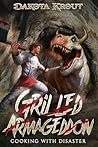
Grilled Armageddon by Dakota Krout My rating: 4 of 5 stars This feels like a grimdark LitRPG to me. The system is totally out to get ever...